“A loving heart is the beginning of all knowledge” — Thomas Carlyle
The sculptor Auguste Rodin once spent an entire afternoon studying a single hand, tracing its lines with such fascination that his assistant worried he'd forgotten to eat. When asked why, Rodin smiled and said that until he truly loved what he was observing, he couldn't sculpt it truthfully. This devoted attention to a single gesture reveals the truth behind Thomas Carlyle's insight that "a loving heart is the beginning of all knowledge." Yet this same devotion creates what we might call a beautiful blindness, a condition that both illuminates and obscures artistic vision.
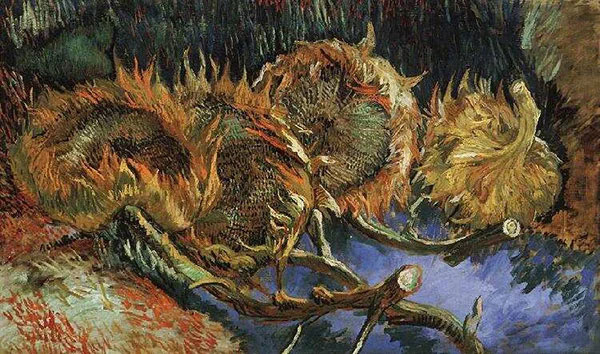
You can see this paradox beautifully in Van Gogh's sunflowers. His letters show us an artist completely enchanted not just by color theory but by genuine affection for these plants. He painted them through different seasons, lighting, stages of bloom and decay. This wasn't just technical practice. His complete absorption led him to discover impasto techniques that laid paint so thick it cast actual shadows, creating surfaces that seem to breathe with life. You can almost feel the weight of that loaded brush in your hand, the resistance of thick pigment against canvas. What we call inspiration wasn't a sudden flash but emerged from this sustained, loving attention that allowed him to see sunflowers in ways no one had before.
Abstract art pushes this passionate myopia to its logical extreme. When painters abandon recognizable subjects entirely, they must fall in love with pure elements. The way red vibrates against blue. How curved lines create tension with angular ones. The emotional weight of empty space. Without familiar objects as anchors, abstract artists become utterly dependent on this intense focus. Their devotion to invisible forces allows them to make the intangible tangible, revealing something profound: that such devoted obsession isn't just helpful for creating art, it's essential for seeing what others cannot. This concentrated engagement paradoxically unleashes creativity by eliminating distractions and conventional thinking, freeing artists to make unexpected connections.
But intensity without judgment breeds self-indulgence. Hemingway's deep attachment to his own experiences occasionally spawned overwrought prose. Abstract painters can become so enamored with their emotional expression that they lose sight of whether their work speaks to anyone else. This passionate immersion can both liberate and constrain creativity, opening new pathways while potentially creating tunnel vision. The real artistry lies in learning to toggle between fervent absorption and stepping back with fresh perspective.
The most lasting art emerges from this delicate balance. When creators channel their focused devotion skillfully, we feel it immediately. There's an unmistakable difference between technically perfect but emotionally vacant work and pieces that pulse with authentic passion. This connection transcends mere skill, forging art that goes beyond showcasing technique to fundamentally alter how we experience the world. Rather than waiting for inspiration to strike, artists transform both their vision and ours through the beautiful blindness of complete absorption, discovering that creativity flows naturally from devoted engagement.
Vincent van Gogh (1853–1890) | Four Withered Sunflowers 1887 | 60 x 100 cm oil on canvas